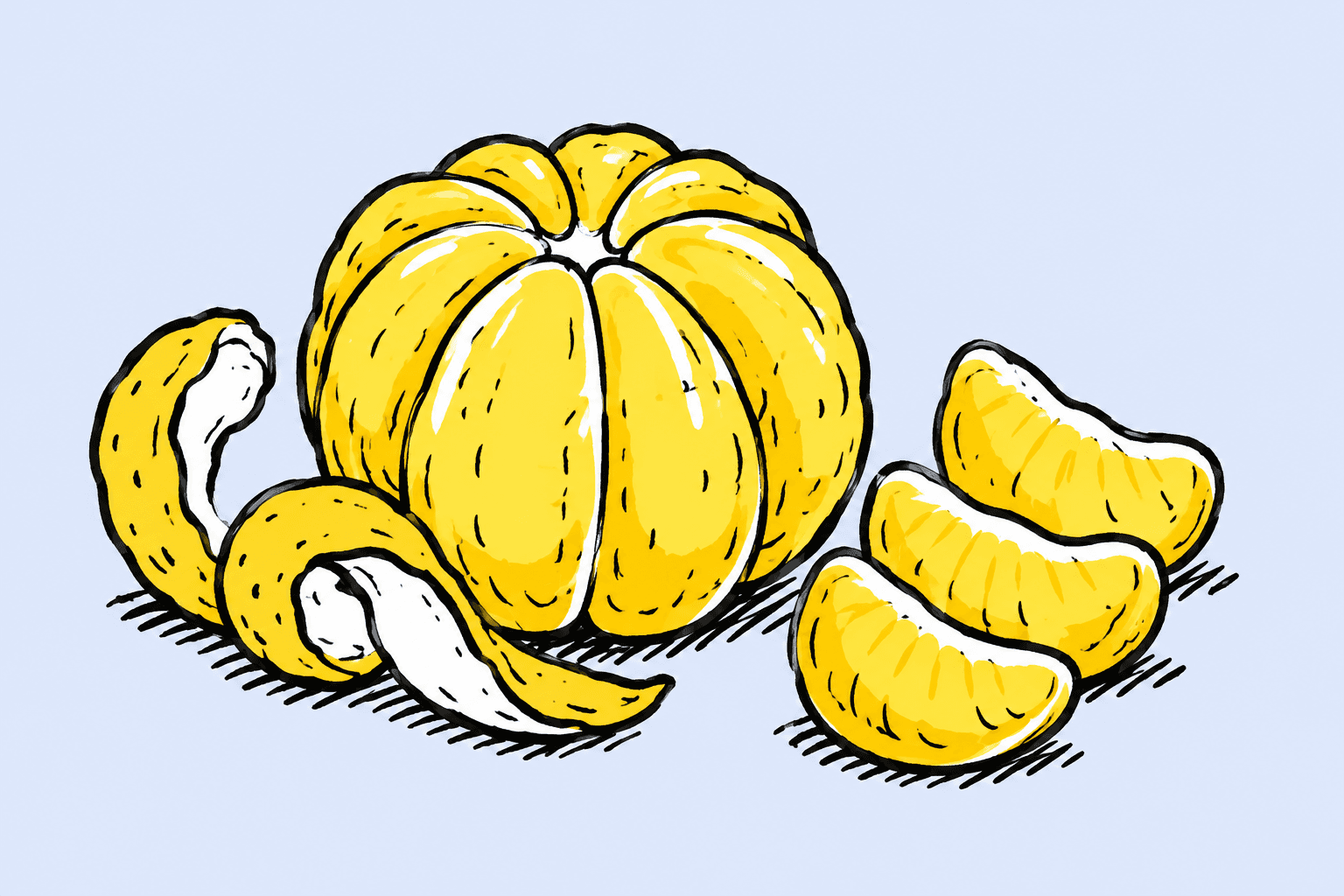
Peel an orange and it comes apart in segments. Your CTC does too. A few segments reach your plate today. The others are set aside for later, or handed to someone else on the way.
TL;DR
What CTC includes
Cost to company (CTC) is everything your employer spends on you in a year. It's a budgeting number for the company, and only part of it is paid to you as monthly salary.
A typical CTC has three kinds of items:
Paid to you every month: basic salary, house rent allowance (HRA), special allowance and other allowances.
Paid on your behalf: your employer's contribution to the Employees' Provident Fund (EPF), usually 12% of basic salary, and sometimes to the National Pension System (NPS) or group insurance.
Paid later, or only if conditions are met: gratuity (a lump sum when you leave after long service) and variable pay or bonus.
Your gross salary is the first group plus any bonus you actually receive. It's the figure tax starts from.
What gets deducted before your salary is paid
Three deductions take you from gross salary to take-home pay:
Your own EPF contribution, usually 12% of basic salary. It's still your money, but it goes into your PF account.
Professional tax, a small state tax in some states, capped at ₹2,500 a year.
Tax deducted at source (TDS), the income tax your employer cuts each month and pays to the Income Tax Department in your name.
Which parts of CTC are taxed
Tax isn't charged on CTC. It's charged on your taxable salary: gross salary minus the exemptions and deductions your regime allows.
For Tax Year 2026-27 (1st Apr 2026 to 31st Mar 2027), taxed under the Income-tax Act, 2025, this is how the main parts are treated:
Part of CTC | New regime | Old regime |
|---|---|---|
Basic salary, special allowance, bonus | Taxed | Taxed |
HRA | Taxed | Partly exempt if you pay rent |
Employer's EPF contribution (up to 12% of salary) | Not taxed | Not taxed |
Employer's NPS contribution | Deductible up to 14% of salary | Deductible up to 10% of salary |
Your own EPF contribution | No deduction | Deductible within the ₹1.5 lakh limit |
Gratuity | Not taxed until paid | Not taxed until paid |
Standard deduction | ₹75,000 | ₹50,000 |
Employer contributions to EPF, NPS and superannuation are tax-free only up to ₹7.5 lakh a year in total. Anything above that is added to your salary as a perquisite.
Remember
How your tax regime changes take-home pay
India has two sets of income tax rules. The new regime has lower slab rates and very few deductions. The old regime has higher rates but lets you claim HRA, investment deductions (Section 123 of the 2025 Act, earlier Section 80C), health insurance and more.
Your employer asks which regime you want at the start of the year, on Form 122. If you say nothing, TDS is cut under the new regime, which is the default. Your choice only decides how much tax is cut each month. You make the final choice when you file your return, as long as you file by the due date.
Under the new regime for Tax Year 2026-27, a rebate brings your tax down to nil if your taxable income is ₹12 lakh or less. For a salaried person, that means a gross salary of up to ₹12.75 lakh after the standard deduction.
A ₹12 lakh CTC, worked out
Example
Riya's CTC is ₹12 lakh a year
Basic salary: ₹5,00,000
HRA: ₹2,50,000
Special allowance: ₹3,66,000
Gross salary: ₹11,16,000
Employer's EPF (12% of basic): ₹60,000
Gratuity set aside by employer: ₹24,000
CTC: ₹12,00,000
From her gross salary, Riya's own EPF (₹60,000) and professional tax (₹2,400) are deducted. Under the new regime her taxable salary is ₹11,16,000 − ₹75,000 = ₹10,41,000, which is under ₹12 lakh, so her TDS is nil. Her take-home pay is ₹11,16,000 − ₹60,000 − ₹2,400 = ₹10,53,600, or ₹87,800 a month.
Riya's take-home is about ₹1.46 lakh less than her CTC, and none of that gap is income tax. Most of it is sitting in her PF account.
What to check on your offer letter
Before you compare two offers, look past the headline CTC:
Find the fixed gross salary. That's what you're paid for sure.
Check how much is variable pay, and what it depends on.
See whether the employer's PF is calculated on full basic salary or on a lower capped amount.
Ask whether gratuity is inside the CTC. You get it only when you qualify for it.
Work out your tax under both regimes before you tell your employer which one to use.
A higher basic salary means more PF and gratuity for the long term but a lower take-home today. Two offers with the same CTC can pay very different amounts each month.
Quick tip
Key takeaways
CTC includes money you never see monthly, such as employer PF and gratuity.
Income tax is worked out on your taxable salary, not on your CTC.
If you don't tell your employer a regime, TDS is cut under the new regime.
General information, not tax advice. Rules change, so check with a CA before you act.