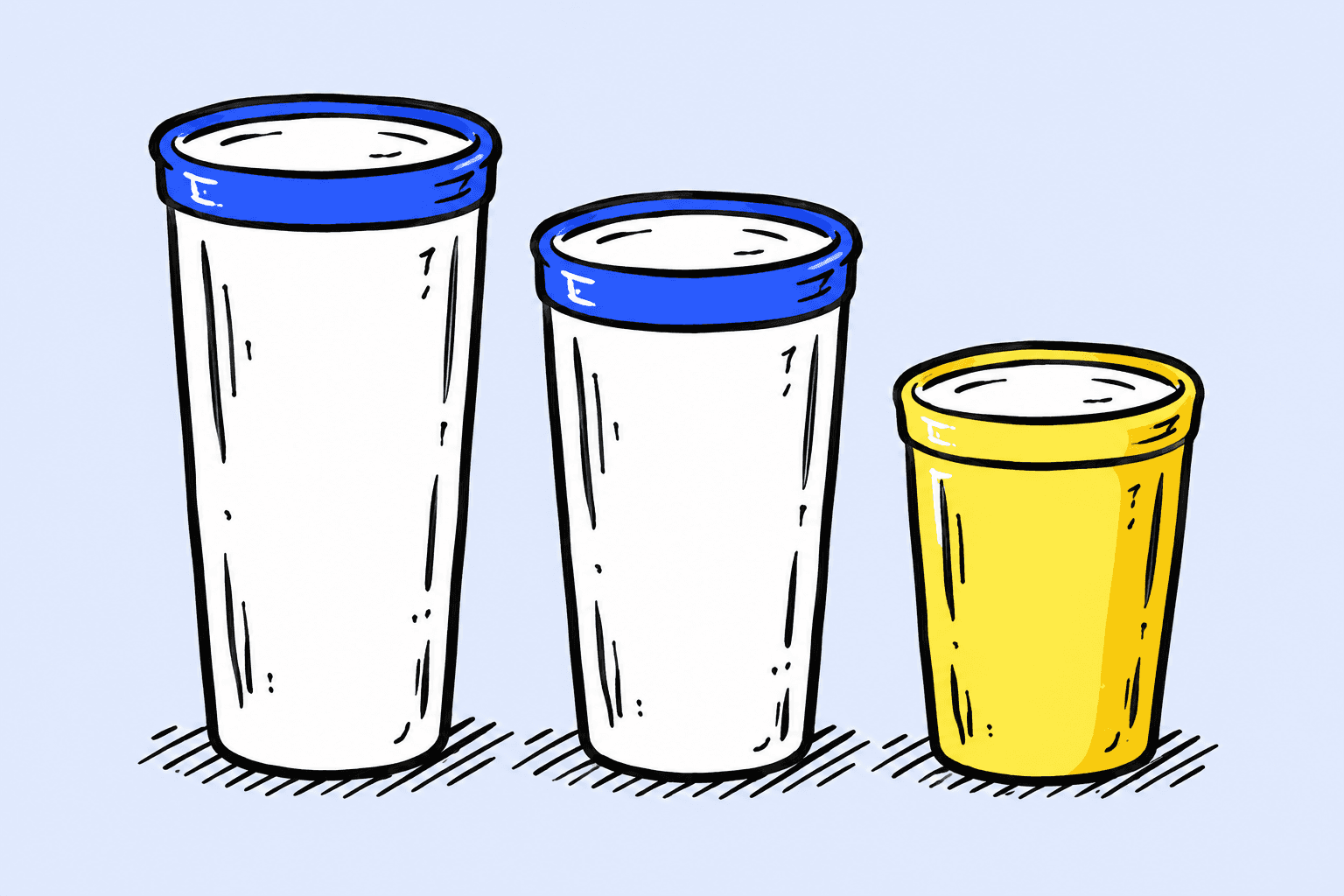
Line up three tumblers and pour. The shortest one decides how much you get. Your HRA exemption works the same way: three measures, and the smallest wins.
TL;DR
What HRA is
House rent allowance (HRA) is the part of your salary meant to cover rent. Your employer decides how much to pay, often 40% to 50% of basic salary. It's taxed like any other salary unless you qualify for the exemption.
When you can claim the exemption
You can claim it for Tax Year 2026-27 (1st Apr 2026 to 31st Mar 2027) if all of these are true:
You've chosen the old tax regime. In the new regime, HRA is taxed in full.
You receive HRA as part of your salary.
You pay rent for the home you live in.
You don't own that home.
The rule is in Schedule III of the Income-tax Act, 2025, which carries forward what was Section 10(13A) of the 1961 Act.
The three amounts that decide your exemption
Your exemption is the least of these three:
The HRA you actually received.
The rent you paid minus 10% of your salary.
50% of your salary if you live in Delhi, Mumbai, Kolkata, Chennai, Bengaluru, Hyderabad, Pune or Ahmedabad, and 40% if you live anywhere else.
"Salary" here means basic salary plus dearness allowance (if it counts for retirement benefits) plus any commission paid as a fixed percentage of turnover. Other allowances and bonuses don't count.
Bengaluru, Hyderabad, Pune and Ahmedabad moved into the 50% group on 1st Apr 2026, when the Income-tax Rules, 2026 took effect.
A worked example
Example
Arjun rents a flat in Pune
Basic salary: ₹50,000 a month, or ₹6,00,000 a year
HRA received: ₹3,00,000 a year
Rent paid: ₹30,000 a month, or ₹3,60,000 a year
The three amounts:
HRA received: ₹3,00,000
Rent paid minus 10% of salary: ₹3,60,000 − ₹60,000 = ₹3,00,000
50% of salary (Pune is one of the eight cities): ₹3,00,000
Exempt HRA: ₹3,00,000. None of his HRA is taxed.
For FY 2025-26, when Pune was in the 40% group, the same figures gave Arjun an exemption of ₹2,40,000.
When the calculation changes during the year
The exemption is worked out period by period. Recalculate it whenever one of these changes:
Your salary or HRA is revised.
Your rent goes up or down.
You move to a city in the other group.
You stop paying rent, for example after moving into your own home.
If your rent is 10% of your salary or less, the second amount is nil and so is your exemption. A low rent with a high basic salary can leave the whole HRA taxable.
Watch out
What your employer needs from you
Your employer gives you the exemption in your monthly TDS only if you declare and prove your rent.
A declaration of rent on Form 124, which replaced Form 12BB, with your landlord's name and address.
Your landlord's PAN if you pay more than ₹1 lakh in rent in the year.
Your relationship with the landlord, if any, which the new form asks you to disclose.
Rent receipts or a rent agreement as proof, usually collected in January.
If you pay rent of more than ₹50,000 a month, you also have to deduct TDS from the rent before paying your landlord.
Missed your employer's deadline for rent proofs? You can still claim the HRA exemption in your return, as long as you file under the old regime by the due date and keep the receipts.
Quick tip
If you don't get HRA at all
Some employers don't pay HRA, and self-employed people never get it. If you pay rent without receiving HRA, the old regime gives a separate, smaller deduction of up to ₹5,000 a month. You can't claim both.
Key takeaways
HRA is exempt only in the old regime, and only if you actually pay rent.
The exemption is the least of three amounts, so paying more rent doesn't always help.
Give your landlord's PAN to your employer if your rent is more than ₹1 lakh a year.
General information, not tax advice. Rules change, so check with a CA before you act.